
In exploring Krishna shringara we must enter the mind of the Krishna kavi, not the modern or the contemporary kavi, not the mind of the kavi that is driven by historic factors and social realities, but the pristine ancient mind that is characterised by dhyana or inward contemplation, a mind that functions with the third eye, a mind that celebrates shringara. That mind of the ancient kavi, which while affirming rationality, takes pride in entering arational spaces of the mind, even while accepting modernity it does not dismiss ancient ideas, even while accepting history as what defines the human condition, it celebrates myth as an alternate source of knowledge, and above all while taking its stand on art history, moves beyond it to aesthetic experience, and seeks for itself poetic truth as the final resting place. That is the home of shringara. Krishna shringara arose from those supra-rational spaces of the poet’s mind, and it is there that it must rest in the mind of the rasika who participates in Krishna shringara. The poet’s mind roams in the vast and beautiful spaces above buddhi, it does not need historical verification or chronological veracity of shringara. It is a mind that seeks moments of beauty and converts it into vistas of eternity, it transforms limited space into infinity, and converts the particular to the universal, while creating poetry of Krishna shringara.
It is said that Krishna poets are born and not created, for every poet is a product of a certain environment that creates and shapes their mind. That aesthetic environment of shringara
is made up of the spaces within the mind and the rhythms of the outside world. In that poetic mind reside samskaras or latent psychic impressions from a previous birth; it has thoughts and ideas; it experiences dreams and emotions and is influenced by the many events of a lived life. Even more it has experienced shringara in this very life. That mind is chastened with various myths and metaphors, with love stories heard in village squares and in the chowk of one’s home. That beautiful mind resonates with stories from street theatre and from the chatter of friends and family. And above all it has a rich store house of Krishna poetry of the past that has flowed down like a river and which nourishes the mind. From all this arise poetic creations of Krishna shringara.
The sounds of a bubbling brook and the mute grandeur of the Himalayas, the playful waves of the ocean, the dark clouds in the sky heralding the rain, the serenity of an azure lake, the highways that lead to the cloud kissing mansions and the footfalls that take us to the peace of a hermitage, the dance of the peacock and the song of the koyal, the colours of the champa and the winding vine around the trunk of a tree are all expressions of Krishna shringara, nay of Krishna himself. The innumerable shining stars in the vast and boundless sky are the words of Krishna’s poem and the hum that comes from the depths of the earth is the atman of that poem. The chirping of the birds is the voice of the poem. The title page of the poem is the sun that arises from the womb of dawn. And the images on the front page of this cosmic poem are the beautiful white flowers of the Parijataka that bloom in the morning and create a carpet on the earth, the shining drops of dew on the blades of grass and rivulets flowing like streams of milk are its lyrics. With every new morning the title page of the book of poetry changes. Krishna once more writes the heading of the book with the first rays of the sun, and as the day progresses the world of nature reads this book and as darkness descends it rests in the pages of the blackness of the night. With the advent of another morning the lines of the poetry start appearing all over again,
the title page forms one more time, the headings are written afresh and nature starts reading this book of poems anew and Krishna stands before us in all his glory as the primal poet.
Krishna as the creator of this cosmic poetry is also the primal witness of His creation. He is both the kavi and the kavya at the same time. His creations are timeless as they defy time. When it comes to Krishna on the road of time history spreads itself like a sheet, and on this path evolves the journey of human beings with measured movement.
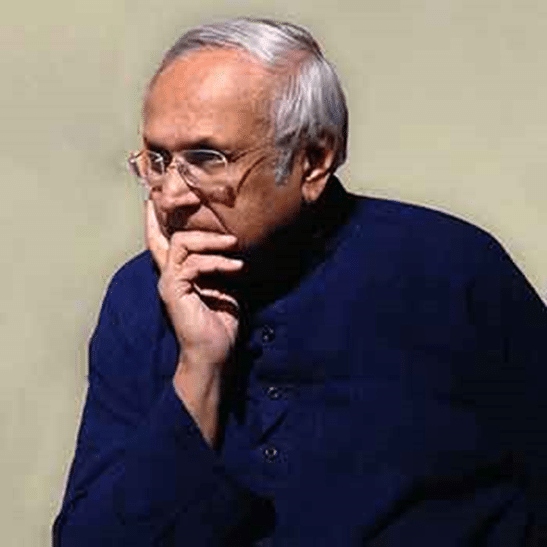
He has a double doctorate, one in Medicine and the other in Ancient Indian Culture both from Mumbai University. He is a practicing Physician and Professor of Philosophy and divides his time between Mumbai (India) and Ottawa (Canada).